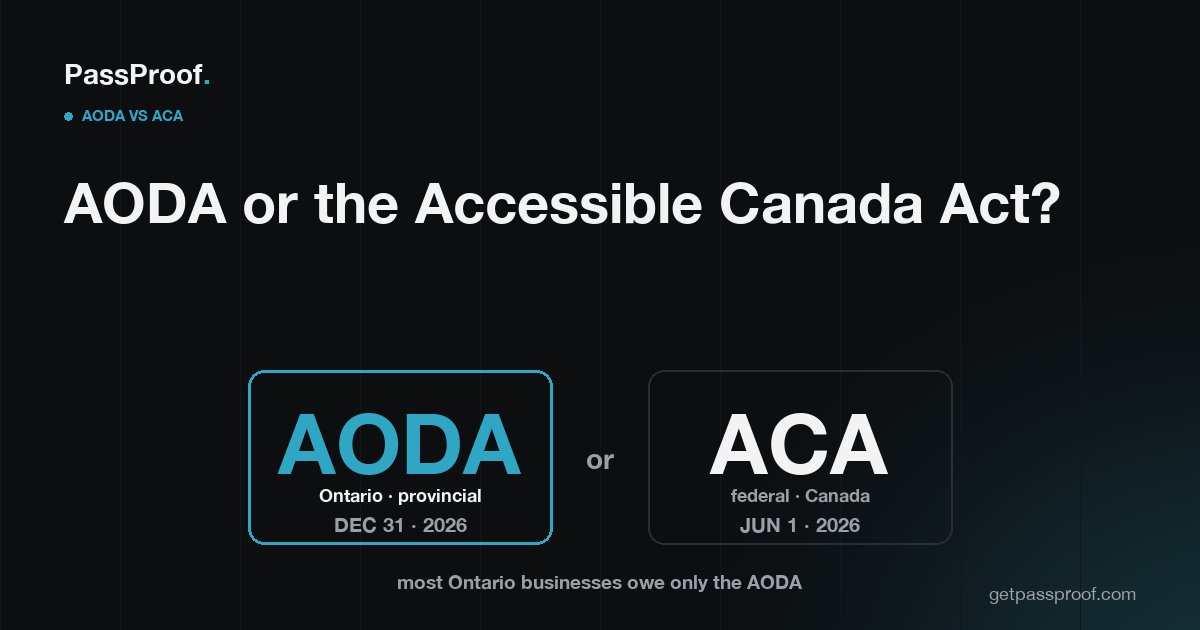
Most Ontario businesses owe the AODA — Ontario's provincial accessibility law — and not the federal Accessible Canada Act (ACA). The ACA applies only if you are federally regulated: a bank, a telecom, a broadcaster, or an interprovincial transport company. A small number of Ontario businesses owe both. Here is how to tell which one is yours — especially now that a federal ACA reporting deadline just passed on June 1, 2026.
Key facts
- The AODA (Accessibility for Ontarians with Disabilities Act) covers provincially regulated Ontario organizations; the next Accessibility Compliance Report is due December 31, 2026 for organizations with 20 or more employees.
- The ACA (Accessible Canada Act, 2019) covers only federally regulated entities; its most recent reporting deadline for large (100+ employee) federally regulated private organizations was June 1, 2026.
- The ACA sets a national goal of a barrier-free Canada by 2040.
- The ACA carries administrative monetary penalties of up to $250,000 per violation — a statutory maximum, not a routine fine.
- Neither law treats an accessibility "overlay" widget as compliance — the U.S. FTC fined the largest overlay vendor $1,000,000 in 2025.
What's the difference between the AODA and the Accessible Canada Act?
The two laws sit at different levels of government. The AODA is provincial — it is an Ontario law, enforced by the Government of Ontario. The Accessible Canada Act is federal — it is a Canada-wide law (passed in 2019) that applies only to organizations under federal jurisdiction.
They do not stack on the same business by default. Which one applies to you is decided by how your business is regulated, not by where your customers live.
Who does the Accessible Canada Act actually apply to?
The ACA applies to federally regulated entities only. That includes the federal government, Parliament, and Crown corporations, plus federally regulated private-sector businesses such as banking, telecommunications, broadcasting, and interprovincial transportation (air, rail, and trucking that crosses provincial or international borders).
It does not apply to most provincially regulated Ontario businesses — the corner shop, the local Shopify store, the regional services firm, the typical small or mid-sized employer. Those fall under the AODA instead.
Does my Ontario business owe the ACA, the AODA, or both?
A quick way to sort it out:
- Provincially regulated (most Ontario businesses): you owe the AODA, not the ACA. If you have 20+ employees, your Accessibility Compliance Report is due December 31, 2026. Here's how to file it.
- Federally regulated (bank, telecom, broadcaster, interprovincial transport): you owe the ACA — accessibility plan, feedback process, and progress reports — and you still owe the AODA for your Ontario operations. You're carrying both.
- Selling into other markets: if you sell into the United States, you also carry ADA exposure (why a U.S. deadline change doesn't help you); if you sell into the EU, the European Accessibility Act has applied since June 28, 2025.
The honest summary: most readers of this page owe one law (the AODA). A federally regulated minority owe two. Knowing which bucket you're in stops you from chasing the wrong deadline.
What was the June 1, 2026 ACA deadline?
Under the Accessible Canada Regulations, federally regulated organizations must publish an accessibility plan (updated at least every three years), run a feedback process, and publish progress reports in the years between plans. For large federally regulated private organizations with 100+ employees, the most recent reporting deadline landed on June 1, 2026. Smaller federally regulated organizations (10–99 employees) are on a later cycle, with their next deadline in June 2027.
If you're a provincially regulated Ontario business, that June 1 date was never yours. Your date is December 31, 2026 — the AODA report deadline. The two get confused constantly, and missing your actual one is the expensive mistake.
What standard does each law use — and does a widget satisfy either?
Different standards, same conclusion about overlays.
- The AODA requires public websites at 50+ employees to meet WCAG 2.0 Level AA today (Ontario has signalled a move toward WCAG 2.2 — here's the difference).
- The ACA's 2025 framework references the Canadian standard CAN/ASC – EN 301 549, which aligns with WCAG 2.1.
Neither law accepts an "instant compliance" overlay widget as a substitute for real accessibility. Independent testing consistently finds automated tools — including overlays — catch only 30–40% of WCAG failures, and in 2025 the U.S. FTC fined the largest overlay vendor $1,000,000 over its compliance claims. Here's why overlays don't hold up. What holds up under either law is the same: a real audit (automated plus manual testing), source-code remediation, and documentation you can show a regulator.
What this means for your business
If you're a typical Ontario business, the June 1 federal deadline you may have seen in the news isn't yours — but December 31, 2026 under the AODA is. If you're federally regulated, you're managing both the ACA and the AODA at once, and the cleanest way to satisfy them is one well-built, WCAG-conformant site rather than two paper exercises. Either way, the real Ontario litigation path runs through the Human Rights Tribunal of Ontario under the Ontario Human Rights Code, which has no employee minimum. Here's how that plays out. The full Ontario picture is in our AODA hub guide.
PassProof is a remote-first accessibility-engineering studio serving Ontario — get a free PassProof Report at getpassproof.com/risk-snapshot.
See which law applies to you — free
The PassProof Report scans your site against Ontario's AODA/WCAG rules in about 30 seconds and returns your top failures in plain English, whether you've got an overlay installed, what legally applies to a business your size, and a fixed-price path to fix it.
👉 Get your free PassProof Report
PassProof is a remote-first accessibility-engineering studio serving Ontario. Accessibility-engineering guidance, not legal advice.