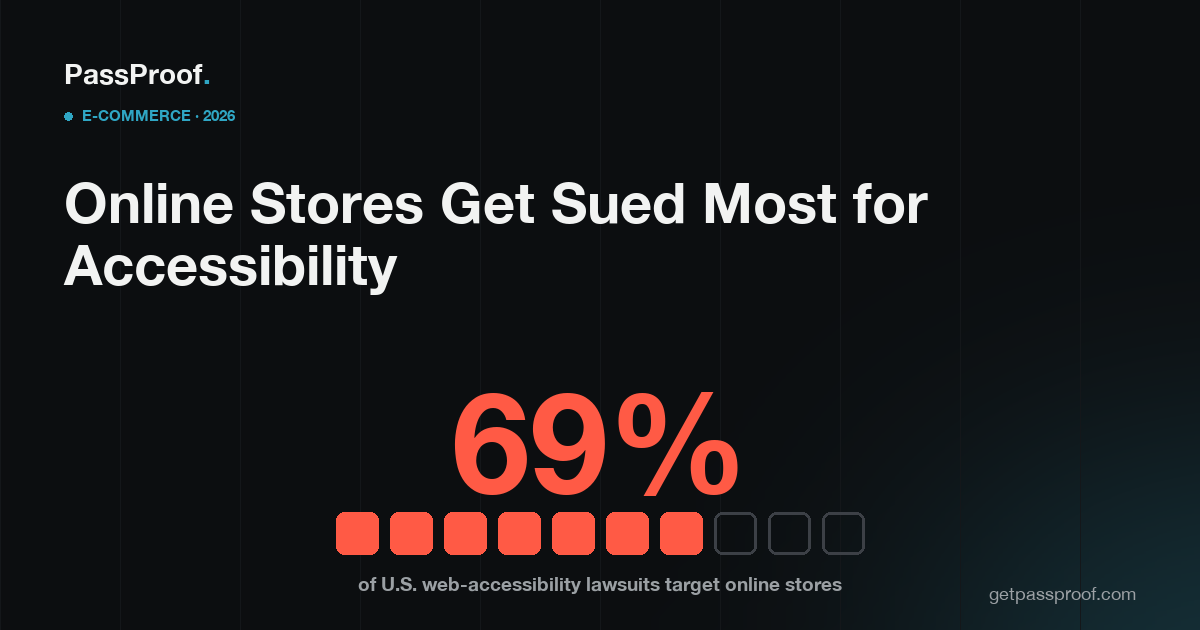
Online stores get sued for accessibility more than any other kind of business: e-commerce sites made up roughly 69% of U.S. web-accessibility lawsuits in 2025, according to the litigation tracker UsableNet. If you run an Ontario shop that sells into the United States — most Shopify and B2B stores do — that statistic is about you, not someone else. Here's why online stores are the bullseye, and what actually lowers the risk.
Key facts
- E-commerce was about 69% of U.S. digital-accessibility lawsuits in 2025 (UsableNet, 2025 Midyear Report) — the single most-targeted sector.
- More than 5,000 web-accessibility lawsuits were filed in the U.S. in 2025, including 3,117 in federal court, up 27% year over year (Seyfarth Shaw and UsableNet).
- About 1 in 5 of the top 500 e-commerce retailers (20%) were named in a lawsuit in 2025 (UsableNet).
- These are ADA (Americans with Disabilities Act) cases; in Ontario the real route is a complaint to the HRTO (Human Rights Tribunal of Ontario), which defending commonly costs $30,000+.
- An accessibility "overlay" widget does not protect you: 456 widget-equipped sites were sued in the first half of 2025 alone, and the U.S. FTC fined the largest overlay vendor $1,000,000 in 2025.
Why are online stores sued more than any other business?
Three reasons stack up. First, an online store is the storefront — if a blind customer using a screen reader can't finish checkout, that's a denial of service a court can see plainly, unlike a static brochure site. Second, e-commerce sites are complex: product filters, image carousels, cart drawers, pop-ups, and date pickers are exactly the components that automated checks miss and that break for keyboard and screen-reader users. Third, plaintiff-side firms can test a store's checkout in minutes and file at volume, which is why e-commerce sits at the top of every tracker year after year. We break down the 2025 lawsuit data here.
Does this apply to a Canadian store, or only U.S. ones?
Both. The roughly 5,000 lawsuits counted above are U.S. ADA cases — but if your Ontario store sells into the United States, you carry that ADA exposure on top. At home, the AODA (Accessibility for Ontarians with Disabilities Act) does not let a customer sue you directly; the real Ontario route is a disability-discrimination complaint to the HRTO, under the Ontario Human Rights Code, which has no employee minimum. Here's how an HRTO complaint plays out. So an Ontario Shopify store can face risk from two directions at once.
Won't an accessibility widget protect my store?
No — and on an e-commerce site it can make things worse. Independent testing consistently finds automated tools, including overlays, catch only 30–40% of WCAG (Web Content Accessibility Guidelines) failures; the broken checkout flows that get stores sued live in the other 60–70%. Plaintiff firms recognize overlay scripts on sight: 456 sites with a widget already installed were sued in the first half of 2025. In 2025 the FTC (U.S. Federal Trade Commission) fined the largest overlay vendor $1,000,000 over its compliance claims. Here's why overlays don't hold up.
What actually lowers the risk for an online store?
The same thing that holds up under both the ADA and the AODA: real source-code accessibility, not a layer on top.
- A real audit — automated plus manual testing of your actual buying flow (search → product → cart → checkout) against WCAG 2.2 AA.
- Source-code remediation — fixing the real HTML and components so the store works with a keyboard and a screen reader whether or not any script is running.
- Documentation — an audit and a remediation plan you can put in front of a regulator, a tribunal, or a plaintiff's lawyer. Accessible stores also tend to convert better, because the same fixes help every shopper. Here's how accessibility and conversion pull together on Shopify.
What this means for your business
If you sell online from Ontario, you're in the most-sued category there is, and you may be carrying it on two fronts: U.S. ADA exposure from American customers and the Ontario HRTO path at home — with your AODA Accessibility Compliance Report due December 31, 2026 if you have 20 or more employees. Here's how to file it. A widget does not cover the checkout that gets stores sued; real remediation does, and it lifts conversion at the same time. The full Ontario picture is in our AODA hub guide.
PassProof is a remote-first accessibility-engineering studio serving Ontario — get a free PassProof Report at getpassproof.com/risk-snapshot.
See where your store stands — free
The PassProof Report scans your site against Ontario's AODA/WCAG rules in about 30 seconds and returns your top failures in plain English, whether you've got an overlay installed, what legally applies to a business your size, and a fixed-price path to fix it.
👉 Get your free PassProof Report
PassProof is a remote-first accessibility-engineering studio serving Ontario. Accessibility-engineering guidance, not legal advice.