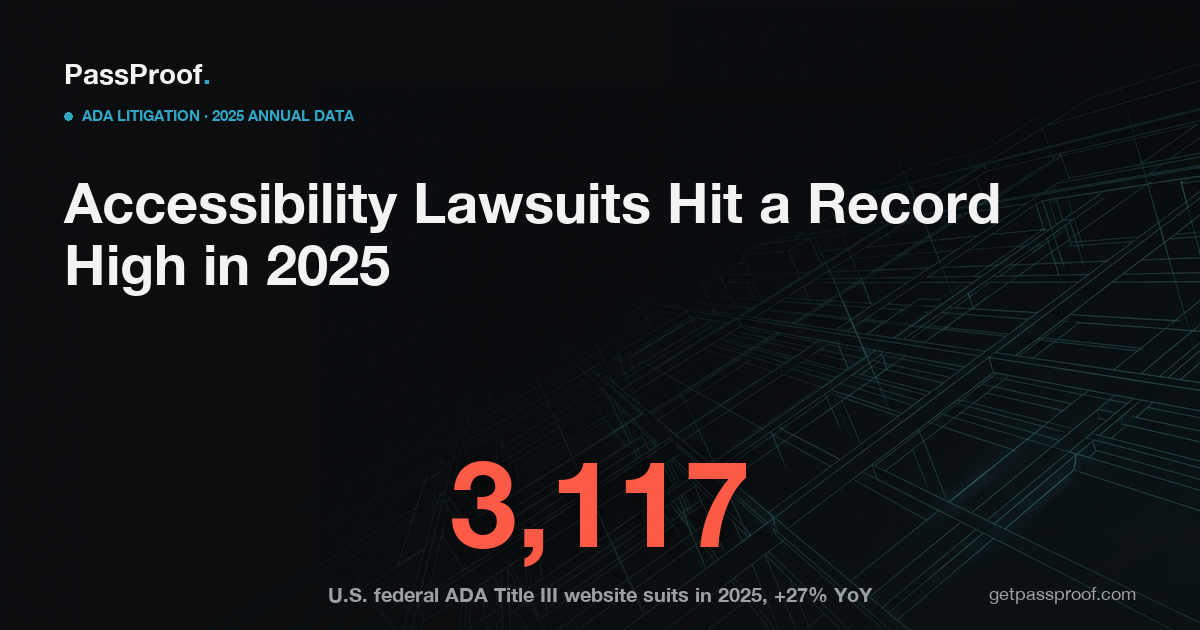
The full 2025 numbers for US website-accessibility litigation are in, and two things stand out. The volume kept climbing — back near its all-time peak. And the geography shifted: the states that used to account for almost every case no longer do. For an Ontario business, the second fact is the one worth a few minutes, because the law driving these suits doesn't stop at the border the way the AODA does.
Key facts
- In 2025, 3,117 federal website-accessibility lawsuits were filed in the US under Title III of the ADA (Americans with Disabilities Act) — 665 more than 2024's 2,452, a 27% increase, and 36% of all federal Title III filings (up from 28% the year before), per Seyfarth Shaw's ADA Title III blog.
- Counting state-court filings, the total exceeded 5,000 web-accessibility suits for the year (Level Access, citing industry litigation trackers).
- The map moved: New York led with 1,021 federal cases and Florida 961, but Illinois jumped to 585 and Minnesota to 162 — while California recorded just 4, after courts there excluded online-only businesses from ADA coverage (Seyfarth Shaw).
- The filings are concentrated in very few hands: in the first half of 2025, 188 plaintiffs filed all 2,014 web-accessibility lawsuits (EcomBack 2025 mid-year report); Illinois' surge was driven largely by a single firm filing 600+ federal cases (Level Access).
- Ontario tie: the AODA (Accessibility for Ontarians with Disabilities Act) has no private right of action, but ADA exposure is live for any Ontario business selling to US customers — and the IASR (Integrated Accessibility Standards Regulation) requires public sites at 50+ employees to meet WCAG (Web Content Accessibility Guidelines) 2.0 Level AA by December 31, 2026.
What did the 2025 numbers actually show?
Two years ago the easy assumption was that this litigation wave had peaked. It hadn't. Federal Title III website cases rose to 3,117, a 27% jump over 2024 and the second-highest annual total on record. More telling is the share: website cases were 36% of all ADA Title III lawsuits filed in federal court in 2025, up from 28% — meaning more than a third of all disability-access litigation in the US now targets websites, not physical premises.
These are still mostly the same pattern of claim: a screen-reader user alleges they couldn't complete a task — usually a purchase — because the site failed common WCAG success criteria. Courts typically reference WCAG 2.1 AA as the benchmark, with 2.2 AA treated as current best practice. None of that has changed. What changed is who's filing, and where.
Why are new states suddenly hotspots?
The headline-grabbing detail in the 2025 data is California: just 4 federal website cases all year. For a state that once anchored this litigation, that's a collapse — and it happened because California courts increasingly hold that the ADA's "place of public accommodation" doesn't cover online-only businesses, while New York rulings have stayed friendly to plaintiffs. Litigation follows favorable law.
So it migrated. Illinois leapt to 585 federal filings, driven largely by one firm filing 600+ cases, and Minnesota climbed to 162. This is a serial-plaintiff economy: a small number of plaintiffs and firms file the overwhelming majority of suits — 188 plaintiffs accounted for all 2,014 web-accessibility cases in the first half of 2025. The practical takeaway isn't "lawsuits are random." It's the opposite — they're systematic, template-driven, and they relocate to wherever the courts are receptive. A business doesn't get targeted because someone has a grievance with it specifically; it gets targeted because an automated sweep flagged its site and the venue was convenient.
That's also why a bolt-on widget doesn't help. An accessibility overlay versus genuine source-code remediation is the difference between a marketing claim and a site that actually works with a screen reader — and the data shows sites running overlays still get sued at high rates.
Does any of this reach an Ontario business?
Under provincial law, the threat model is milder. The AODA carries no private right of action, so an Ontario customer can't bring an ADA-style suit against you under accessibility law. Ontario's routes are the regulatory compliance-report process and an individual complaint to the HRTO (Human Rights Tribunal of Ontario) under the Ontario Human Rights Code — here's how a single HRTO complaint actually plays out.
The part that crosses the border is the ADA. If your Ontario store sells to American shoppers — most e-commerce does — your website is reachable under the same law behind all 3,117 of those 2025 cases. Why online stores get sued most for accessibility explains why checkout, product, and form flows are the usual targets. And the geographic spread makes the old "we're not in a hotspot state" comfort meaningless: the hotspots move, and a serial-plaintiff sweep doesn't check where your warehouse is.
What should you do before a claim finds you?
The defensible position is the same one that survives in court: a site you've actually tested and fixed, with a record to show for it. A recent New York case was dismissed precisely because the company could prove ongoing, documented remediation — not a promise, an audit trail. Start by learning where you genuinely stand, prioritize the flows that carry real risk, fix them at the source, and keep dated evidence — an Accessibility Conformance Report (ACR) and a remediation log. That same work is what closes your IASR gap before the December 31, 2026 compliance-report deadline, so the budget does double duty. What an AODA audit and remediation actually costs shows where that spend goes.
See what an automated scan flags on your site in about 30 seconds — free PassProof Report: getpassproof.com. It detects overlays, tells you what legally applies in Ontario, and shows where the real gaps are — no scare tactics, just the facts.
PassProof is a remote-first accessibility-engineering studio serving Ontario. General information, not legal advice.